Vertical Farming in India: A Modern Agriculture Practice


As the population grows and urbanization increases, the availability of arable land for traditional farming methods will decrease. Vertical farming is a modern solution for food production in urban areas, making it accessible for regions with limited space. It is an interesting way to grow crops in a closed and controlled environment vertically, saving water and land space, and attaining 365 days of production of fresh fruits and vegetables. Hence, vertical farming acts as a solution for growing food demands in limited arable land. Let's learn about this new agricultural approach in detail, knowing its methods, advantages, and challenges faced in India, in this blog.
Table of Content
- What is Vertical Farming?
- Different Types of Vertical Farming
- Major Advantages of Vertical Farming
- Vertical Farming Model: How it works
- What are the Popular Methods of Vertical Farming?
- Challenges Faced in Adopting Vertical Farming
- Future of Vertical Farming Technology in India
What is Vertical Farming?
The agricultural techniques, where crops are grown indoors in vertically stacked layers without soil is called Vertical farming. This is a type of controlled environmental agriculture (CEA) that operates on human-made conditions to offer maximum growing space for crops. This type of farming is mainly useful for urban or land-scarce areas, which enables higher crop yields per area. This farming technique uses indoor spaces regulated with controlled temperature, humidity, light, and water supply.
The three main soilless methods used in vertical farming are hydroponics, aquaponics, and aeroponics. Two years before, the valuation of the vertical farming market was USD 82.7 million and is projected to increase to USD 579.7 million in the next seven years.
Different Types of Vertical Farming
The different types of vertical agriculture farming depend on several factors. And various crops demand available space, budget, and utilities. Here are some examples of vertical farming ventures in India:
Mushroom Production
The production of mushrooms is one of the most successful forms of vertical farming. Mushrooms don't need much sunlight and can thrive on organic waste. They can easily grow in temperature-controlled environments. In this method, mushrooms are cultivated in trays, shelves, and stacked layers.
Poultry Production
Poultry farming is mainly done in battery cages that can keep many birds. The poultry birds, particularly kept for egg production and meat, are grown over multi-story structures with floors or battery cages.
Garden Wall/Bio Wall
Vertical gardening is an innovative idea where you transform vertical spaces into lush green spaces by growing plants. These plants can be herbs, fruits, or vegetables on the walls. This farming technique is best for urban areas where space is limited.
Hydroponic Fodder
A viable way to maximize the use of resources and minimize the waste level is to overcome issues like land scarcity and water scarcity. This way, the livestock farming sustainability is improved, offering a regulated environment to produce nutrient-rich sprouting grains.
Strawberry Vertical Farming
Traditional strawberry farming is mostly limited to various factors, like soil texture, available space, and climate variations. This farming addresses challenges by providing a controlled environment where good-quality strawberries are cultivated. Due to the intervention of external factors, vertical farms help produce more harvest cycles and significantly higher yields.
Cucurbits Trained Vertically
Traditionally, cucurbitaceous crops are cultivated on the ground horizontally. This way it occupies a lot of space and is prone to several insect pests and diseases. Vertically farming of cucurbits plants helps tackle these challenges to produce healthy yield. The important cucurbit crops in vertical farming include bottle gourd, cucumber, sponge gourd, snake gourd, ridge gourd, and bitter gourd.
Microgreens
Microgreens are young, edible seedlings of vegetables and herbs, harvested 1-3 weeks after germination, at the cotyledon or first true leaf stage. In vertical farming, microgreens are one of the most ideal crops due to their small size, short growth cycles, and minimal space requirements. Microgreens typically grow on vertical farms for 2 to 3 weeks. During a single cultivation cycle, it is possible to sow multiple seed species simultaneously. They are grown in hydroponic vertical farming systems and are cultivated on mats made of natural fibers such as hemp, flax, or coconut.
Farm Containers
Container farming is a method of growing crops in a controlled environment within shipping containers. The containers are climate-controlled and use indoor growing lights to replicate sunlight, creating optimal growing conditions year-round. These ‘farms’ can be placed virtually anywhere, from urban rooftops to rural areas, providing fresh produce locally and reducing transportation costs and carbon footprints.
Major Advantages of Vertical Farming
The major advantages of the vertical farming model include efficient land use, a 365-day crop production cycle, reduced chemical use, and water conservation.
- The concept of vertical agriculture uses less land space with relatively more crop yield. In vertically stacked structures, the per square meter crop yield is much higher.
- The two types of vertical farming, aeroponics and hydroponics, utilize less water than the traditional methods. Due to its closed-loop system, water is recirculated frequently, reducing water wastage.
- The use of pesticides and herbicides is less in indoor environments. Also, in a controlled environment, the risk of diseases and pests is minimal.
- Vertical farming is climate-resilient, which helps increase the annual production possible. This closed-loop technique protects the plants from seasonal changes and extreme weather conditions.
Vertical Farming Model: How it works
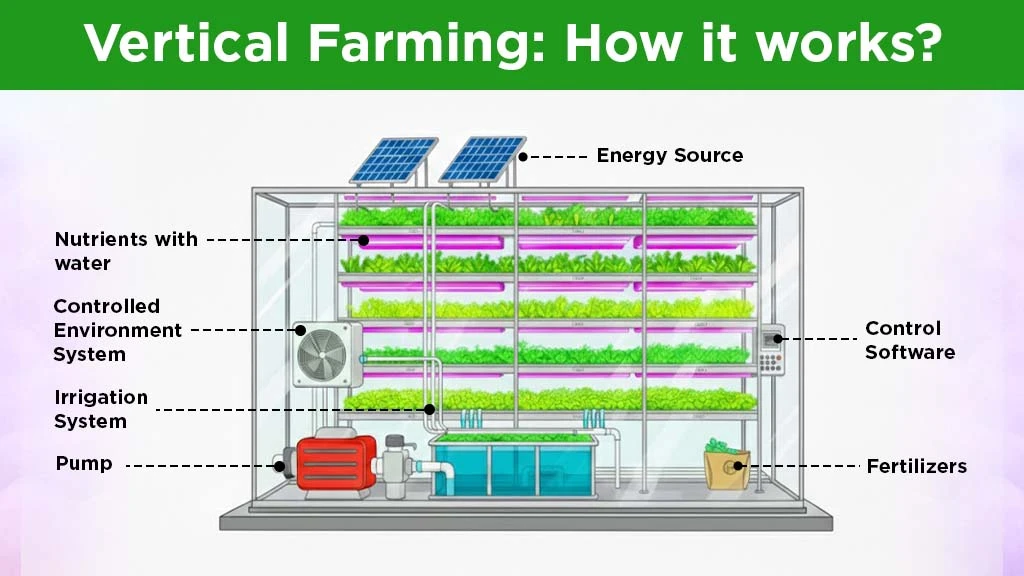
The basic method of vertical farming is to arrange plants vertically rather than horizontally. This production is mostly done indoors, as it creates an optimal atmosphere for plants.
The four major understandings behind the functioning of these farming methods are:
- Requirement of cylindrical tower-like structure to grow crops in layers one above the other. This way, it aims for more crop production in every square meter.
- This farming needs ample artificial lighting over the crops, like LED lights. This helps in enhancing lighting efficiency while being cost-effective. A balance of both natural light and artificial lighting ensures a suitable light level in the room.
- Mainly, this farming type does not use soil, as it focuses on soilless technologies like hydroponics, aquaponics, and aeroponics.
- Vertical agriculture supports sustainable practices to produce eco-friendly food, resulting in less use of water, chemicals, and the reuse of resources.
What are the Popular Methods of Vertical Farming?
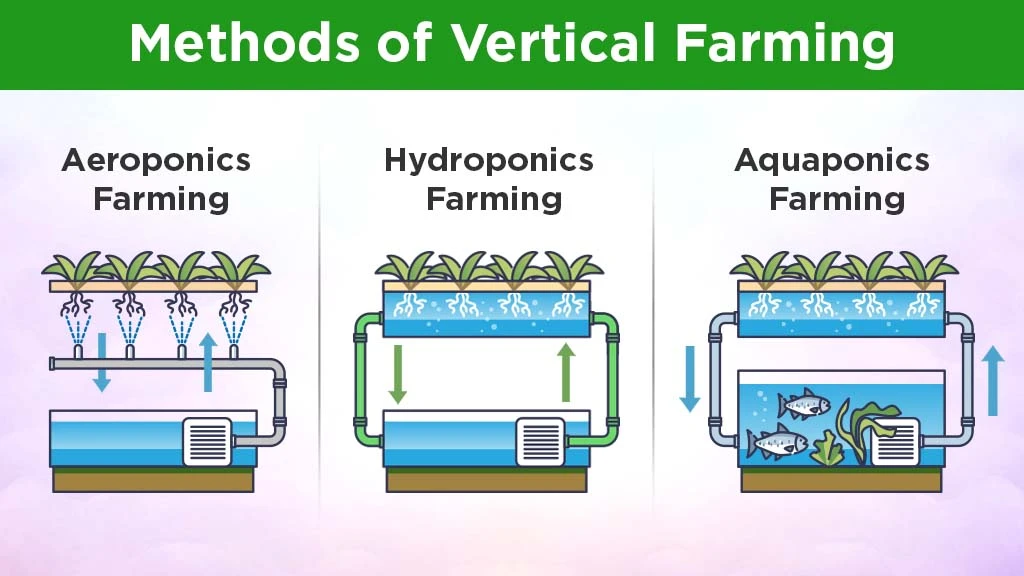
Vertical farming is broadly classified as 3 popular soilless methods. Let's understand each of them below:
Aeroponics
This is a highly technical method where the plant roots are suspended in a humid air environment with nutrient-rich mist regularly sprayed on them. There is no liquid or solid medium used in this method. Mainly, air is the key source for producing crops in this farming technique. With less water use, aeroponics farming allows for faster growth.
Hydroponics
Hydroponic is the most widely used method of farming, where plants grow in a nutrient-rich, aqueous solution. This process helps deliver nutrients and minerals directly to the roots.
Aquaponics
This is a symbiotic farming technique that blends traditional fish farming with soilless plant cultivation. Simply, this farming cultivates fish and plants together, creating a balanced system where the plants purify the water used for fish. Later, the same water acts as the fertilizer for plants, as it is nutrient rich.
Challenges Faced in Adopting Vertical Farming
The major challenges in adopting vertical farming in India include high costs and high energy consumption. The other challenges include:
- Cost-intensive cultivation.
- Viewing vertical farming as supplementary farming.
- Partial or no-plant nature interaction.
- Developing ideal varieties or hybrids of ideal crops.
- Lack of infrastructure and expertise.
- Producing unpleasant odour/smell over time (cannot be referred to as total environment-friendly technology).
Future of Vertical Farming Technology in India
The future of vertical farming in India seems bright, with the flourishing market projected with significant growth, leveraging AI, loT and automation for efficient sustainable food production.
- Ai-driven farming and loT farming solutions allow monitoring of real-time environmental factors, enhancing better plant growth and less resource use. This initiative of precision agriculture technology aligns with the goal to enhance food security while reducing the agricultural footprint of India.
- According to UN, the urban population in India will approximately reach
600 million by 2030. With this shift, the growth of vertical farming will expand in cities like Mumbai and Delhi where land constraints can make traditional ways of farming impractical. Vertical farming will be an eco-friendly choice for big cities in the coming years.
Frequently Asked Questions On Vertical Farming in India: A Modern Agriculture Practice
1. Is vertical farming possible in India?
Yes, vertical farming initiatives are possible in India, demonstrating the potential of this innovative approach.
2. What is the biggest problem with vertical farming?
The biggest challenges in vertical farming are its initial setup costs. These costs include specialized equipment like hydroponic systems and growing lights that cost more and can be expensive.
3. What are the most profitable crops in vertical farming?
Leafy green vegetables like lettuce, kale, spinach, arugula and other leafy greens are considered more profitable due to their compact growth and short harvesting cycles.
4. How to start vertical farming?
To start with vertical farming analyze these steps: Know your goal, study the market, choose your crop preference, select suitable technology, craft your business model, estimate your ROI, get hold with the right contractor and you are ready to start your journey.
5. Is there any government subsidy for hydroponic farming?
Yes, the National Horticulture Board (NHB) provides 50% to 75% subsidies for protected cultivation, including hydroponics.




Related Blogs